29/08/2011

Focus sur les formations packaging II


Après avoir vu les différents DUT GCE en France, nous allons nous intéresser aux poursuites d’études possibles. Les premières d’entre elles sont les licence pro packaging. Elles sont assez nombreuses donc je vous citerai toutes celles que j’ai trouvé puis je m’attarderai sur une. Les voici :

·         Adaptation des Emballages et Design Industriel EN ALTERNANCE (apprentissage ou Contrat de Professionnalisation), IUT d'Évreux
·         Emballage et conditionnement des produits du vivant - ALIPACK, IUT de Montpellier
·         Conception des Emballages et Design Industriel, IUT de Reims
·         Technico-commercial en emballage et conditionnement - FORMAPACK, CCI - IUT de Morlaix  
·         Design produits et Packaging, Villefontaine - IUT de Chambéry
·         Transformation et conditionnement des produits alimentaires - IUT de Lyon
·         Technologiste Emballage*, ESEPAC - Clermont-Ferrand
·         Technicien supérieure Packaging, FSPack – Cognac

L’admission se fait généralement après avoir obtenu un DUT ou un BTS et envoyé un dossier de candidature. Des dérogations sont toutefois possibles après un passage devant une commission. Vous pourrez trouver des formations continues ou en alternance suivant vos souhaits.

Je vais maintenant un peu plus m’attarder sur la formation de Cognac. La formation inclut un stage obligatoire en entreprise de 12 semaines et s’appuie sur :

·         La conception, réalisation et l’intégration de tout ou partie d’un projet en matière d’emballage en liaison avec une entreprise industrielle.
·         La réalisation de divers tests d’emballages.
·         La modélisation et la mise en place de méthodes permettant l’aboutissement du projet.
·         L’élaboration des dossiers de réalisation.

Contenu de la formation

En liaison directe avec les entreprises industrielles notamment celles du domaine de l’emballage et du conditionnement, les étudiants doivent avoir:

·         Un niveau correct en enseignement général.
·         Le sens de l’organisation, de la gestion et de l’analyse.
·         Le sens des responsabilités et de l’initiative.
·         L’intérêt de la communication.

Enfin au-delà des aspects formations et profils des étudiants, le gros point fort de la formation  est sont parc machine. En effet beaucoup de tests sont possibles pour simuler tout types de situations d’un emballages. Des entreprises viennent d’ailleurs tester leurs emballages sur la machine de traction, le simulateur de transport ou l’enceinte climatique. Pour le prototypage, les étudiants pourront utiliser CATIA et la table de découpe ou l’imprimante 3D.

Comme pour le DUT GCE, les débouchés sont importantes pour des métiers allant de Chef de Produit à Responsable de production, en passant par Concepteur de PLV.


Parc machine

Plus d'infos sur : http://www.formation-packaging.fr/

Focus on Packaging training II

After seeing the various TPSD in France, we will focus on prosecution of possible studies. The first of them are professional packaging degree. They are numerous so I will give you all the ones I found and I dwell on. They are:

·         Packaging Adjustment and Industrial Design ALTERNATING (apprenticeship contract "), IUT d'Evreux
·         Packing and packaging live products - ALIPACK, IUT Montpellier
·         Design of Packaging and Industrial Design, IUT de Reims
·         Technical and commercial packaging and packing - Formapack CCI - IUT de Morlaix
·         Products Design and Packaging  Villefontaine - IUT de Chambery
·         Processing and packaging of food products - IUT Lyon
·         Packaging Technologist * ESEPAC - Clermont-Ferrand
·         Superior Packaging Technician, FSPack – Cognac

Admission is usually after having obtained a DUT or a BTS and sent an application form. However, exceptions are possible after an appearance in front of a commission. You can find further training or alternating training according to your wishes.

I will now dwell a little on the formation in Cognac. The training includes a mandatory internship in a company of 12 weeks and it is based on:
·         The design, implementation and integration of all or parts of a project on packaging in conjunction with an industrial company.
·          Completion of various packaging tests.
·         Modeling and implementation of methods to complete the project.
·          Development of achievement records.

Direct linkage with industry including the field of packaging, students must have:

·         A good standard of general education.
·         The sense of organization, management and analysis.
·         A sense of responsibility and initiative.
·         Good communication skills.

Finally, beyond the training aspects and student profiles, the big highlight of the training is the machine park. Indeed, many tests are possible to simulate all types of packaging situations. Companies are also testing their packaging on the traction machine, the transport simulator or the climatic chamber. For prototyping, students will use CATIA and the cutting table or the 3D printer.
As for the TPSD, jobs at the end of the training, you will have access to various jobs, like Product Manager or Designer.

23/08/2011

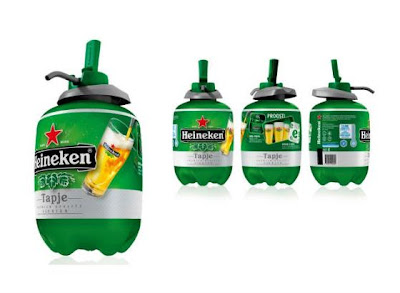
Heineken lance le fût de bière en PET

Les marques de bière Heineken et Amsteel ont lancé un nouveau fût de bière de quatre litres en PET avec robinet intégral. Dénommé "Tapje", c’est un petit système de bière pression que les consommateurs peuvent utiliser à la maison. Il a été lancé aux Pays-Bas avant son introduction dans d’autres marchés.

Fabriqué par APPE, le fût en PET présente la technologie de barrière monoBLOXTM propriété de la société. Des récupérateurs d’oxygène aboutissant à un conteneur robuste du fait de la résistance supérieure des barrières permettent de protéger la bière, en ne laissant pas entrer l’oxygène et tout en gardant le dioxyde de carbone. Une fois ouverte, la bière reste fraîche durant 30 jours, assure le fabricant. Un indicateur coloré sur le dessus du fût indique quand la bière a atteint le niveau de température correct pour une bonne consommation.

Une équipe de travail conjointe entre APPE et son site belge et Heineken a travaillé pendant plusieurs mois sur ce projet.

Reproduction interdite sauf accord écrit d'Emballage Digest ou mention du support
               

The beer brands Heineken and Amsteel have launched a new PET barrel beer with full tap. This is a small draft beer system called “Tapje” that consumers can use at home. It was launched in the Netherlands before its introduction into other markets.
Made by APPE, the PET barrel was created with the barrier technology monoBLOXTM .
Recuperators of oxygen resulting in a robust container due to the superior strength of the barriers used to protect the beer, not allowing oxygen to enter and while keeping the carbon dioxide. Once opened, the beer stays fresh during 30 days. A color indicator on top of the barrel indicates when the beer has reached the proper temperature for proper use.

A joint task force between APPE site and its Belgian and Heineken has been workingfor months on this project.


26/06/2011

2012, le changement


Autres que l’élection présidentielle et la fin du monde, des changements sont à prévoir pour l’année 2012 au niveau emballages et éco-conception.

Le nouveau barème Point vert vise à augmenter le recyclage des emballages et limiter leur nombre. Le nouveau calcul va prendre en compte la contribution au poids et la contribution à l’unité, auquel s’ajoutera un bonus ou un malus. Ce changement aura une forte incidence sur le design et le choix des matériaux des emballages.
La contribution au poids sera variable selon le matériau. Elle se basera sur :
·         les coûts nets de collecte et de recyclage de chaque matériau
·         leur participation à l’objectif de recyclage.

Ce changement entrainera une forte augmentation du verre (+150%) et de l’aluminium (+53%) alors que l’acier n’augmentera que de 4,5%.
L’autre évolution concerne la contribution à l’unité. Elle vise à limiter le nombre des éléments constitutifs de l’emballage d’un même produit. Alors que jusqu’à maintenant une bouteille et son bouchon étaient considérés comme une seule unité, à partir de 2012, les deux deviennent chacun un élément qui en tant que tel paiera donc une contribution, et ce en fonction de son matériau.
Enfin, les bonus et aux malus visent à inciter les entreprises à davantage intégrer l’éco-conception dans leurs emballages. Ainsi, les emballages qui mettront en œuvre des actions de prévention ou qui porteront des messages de sensibilisation au tri bénéficieront d’un bonus de 2%. En revanche, les emballages non valorisables ou sans filière de recyclage seront majorés de 100%, les emballages figurant sur la liste des perturbateurs seront eux majorés de 50%.

                L’autre changement important qui était attendu pour 2012 était l’augmentation du taux de recyclage des emballages ménagers. En effet l’objectif fixé par Eco-emballages de 75% était (trop) ambitieux et il est reporté à 2015. Le nouveau barème du Point vert 2012 devrait aider à tenir ce délai grâce au principe du pollueur payeur.
                Si le conditionneur fait de l’éco-conception, utilise des matériaux recyclables et permet un tri plus facile en fin de vie, il recevra des bonus. Sinon il aura des malus.


2012, change


Other than the presidential election and the end of the world, changes are anticipated for 2012 in packaging and eco-design.

The new “Point vert” scheme aims to limit the packaging and increase its recycling. The new calculation will take into account the contribution for weight and contribution per unit, plus a bonus or a penalty. This change will have a strong impact on design and choice of packaging materials.

The contribution to the weight will vary depending on the material. It is based on:
·         the net costs of recollection and recycling of each material
·         participation in the recycling target.

This change will cause a sharp increase in the glass (+150%) and aluminum (53%) contribution while the steel will increase by only 4.5%.
The other change concerns the contribution per unit. It aims to limit the number of components of the packaging. Up to now a bottle and its cap were considered a single unit, from 2012, the two become independant items that everyone would pay a contribution for, according to its material.
Finally, bonuses and penalties are designed to encourage more companies to integrate eco-design in their packaging. Thus, packages that implement preventive actions or that will bring sorting awareness messages receive a bonus of 2%. In contrast, non-recyclable packaging or without recycling industry will be increased by 100%, the packaging that disrupts them will be on the list increased by 50%.

The other major change that was expected for 2012 was the increased rate of recycling of household packaging. Indeed the goal set by eco-packaging of 75% was (too) ambitious and it has been postponed to 2015. The new scale “Point Vert” 2012 will help meet that deadline due to the principle of if you pollute, you pay.
If the packager makes eco-design, he uses recyclable materials and allows for easier sorting in late life, he will receive bonuses. Otherwise it will receive a penalty.

14/06/2011

Le film VCI


Je vais présenter aujourd’hui un emballage qui a remplacé une étape dans le process industriel de plusieurs entreprises. Il s’agit du film VCI.
Les produits VCI sont une solution pour supprimer le huilage des pièces industrielles. Le film procure une protection sèche contre la corrosion en venant saturé le milieu où il se trouve et en déposant une couche moléculaire protectrice sur le métal.

Pour le fabriquer, on introduit un additif « VCI » dans la masse de polyéthylène (sorte de plastique) encore fondue pendant la phase de coextrusion du film. Il est ensuite soufllé puis enroulé pour faire des rouleaux de housses.
Le film se sépare en 3 couches :
·         L’une pour protéger immédiatement les pièces conditionnées
·         L’autre qui contient le produit
·         La dernière agit comme barrière contre les agents atmosphériques Cette couche empêche aux molécules VCI  de se répandre, garantissant le développement de la protection à l’intérieur de l’emballage.


Ce procédé a été adopté depuis longtemps dans l’automobile et se démocratise de plus en plus puisque les rouleaux sont vendus maintenant dans les plus grands distributeurs d’emballage français et mondiaux.


Même si, à première vue, on peut penser que cela rajoute encore des emballages, son impact environnemental est beaucoup moins important qu’un poste de huilage d’une entreprise.  Ce produit montre un fois de plus certaines vertus de l’emballage  : économique, écologique et facile d’usage.


Today, I will present a package which replaced a step in an industrial process for many companies. This is the Vapour Corrosion Inhibitor (VCI) film. 
VCI products are an environmentally friendly, economical and practical to remove the lubrication of industrial parts. The dry film provides protection against corrosion due to the saturated environment where it is and by filing a protective molecular layer on the metal. 
To do that, we introduce an additive "VCI" in the mass of polyethylene (type of plastic) yet melted during the coextrusion of the film. It is then blown and afterwards wound into rolls of bags. 
The film divides into three layers: 
·         One to protect parts immediately packed 
·         The other contains the product
·         The latter acts as a barrier against the elements This layer prevents the VCI molecules to vaporize, ensuring the development of protection inside the package. 
This method has been adopted a long time ago in the automotive industry and increasingly democratized since the rolls are now sold in the largest distributors of packaging.
Although at first glance, one might think that this adds another packaging, its environmental impact is much less important than the position of oiling parts. This product shows once more certain virtues of the package: economic, ecological and easy to use. 

07/06/2011

Focus sur les formations packaging I

Bonjour à tous,

Cela faisait un certain temps que je n’avais pas écrit d’article et il m’a semblé important de parler des formations de nos techniciens et ingénieur packaging. Ces filiales, pourtant méconnues, sont des bonnes opportunités pour découvrir un monde toujours en évolution, où les débouchés professionnels sont nombreuses.
Notre premier focus se fera sur le DUT Génie du Conditionnement et de l’emballage. Il a été créé en septembre 2000 à Reims et forme en France des techniciens supérieurs en emballage. Cette formation donne une vision globale du cycle de vie des emballages et est orientée suivant 4 axes principaux :

la Conception et le Design d'emballage
l'analyse et la maîtrise de la qualité des emballages
la logistique des flux de distribution
 la formation générale

Les IUT dispensant cette formation sont 5 (Evreux, Reims, Castres, Chambéry et Avignon). Ce sont des effectifs de 50 étudiants maximum par promotion, ouvert à la tous les bacs ce qui permet d’avoir une richesse de compétences parmi les étudiants. A la fin, c’est un taux de 90% de réussite avec de nombreuses offres d’emploi à la clé comme, par exemple, technicien développement.

Il existe quelques différences entre les IUT proposant cette formation. Certains sont plus axés graphisme, comme à Chambéry, et d’autres sont plus techniques. C’est le cas par exemple à Evreux où la formation dispose d’un parc machine conséquent. Les étudiants peuvent donc, dès le début, s’initier à une table de découpe, une encartonneuse, des remplisseuses (liquide et visqueuse),…

C’est donc un diplôme technique, scientifique et général qui permet d’accroitre ses compétences dans plusieurs domaines. Des poursuites d’études sont possibles mais nous en reparlerons dans des futurs articles.


Focus on packaging training

Hello everyone,

It's been a while since I have written an article and it seems important to mention the training of our packaging technicians and engineers. These subsidiaries, yet unknown, are good opportunities to explore an ever changing world, where career opportunities are numerous.

Our primary focus will be on the Technical School Packaging Degree (TSPD). It was created in September 2000 in Reims in France to train junior technicians in packaging. This training provides an overview of the life cycle of packaging and is orientated on four main axes:
 
Packaging Design & Conception
Packaging  Analysis and Quality control
Logistics distribution flows
General Education

The TSPD is providing this training in 5 places (Evreux, Reims, Castres, Chambery, Avignon). There are 50 students per class maximum, it is open to all High School students, which provides a wealth of skills. At the end of the course, there is 90% rate of success with many job offers in hand, for example, development technician.

There are some differences between the Technical School offering this training. Some are more graphics orientated like in Chambéry, and others are more technical. This applies, for example in Evreux where training has a fleet of machines. Students can therefore, from the beginning, learn about a cutting table, a packer, fillers (liquid and viscous), ...

So it's a technical, scientific and general diploma which enhances skills in several areas. The continuation of studies is possible, but we'll talk about it in future articles.